by PICKETBOAT » Sun Apr 28, 2013 8:05 am
Hi all
As the painting of the model reached its conclusion, I started on the mast construction. The masts were installed very near the end of the build for obvious reasons. They are strong enough to stand any normal use on the water, but it is very easy to get things hooked round them and do a lot of damage, plus they get in the way during the painting.
This model was the first I had built that depicted radio (WT) aerials, so I had to think how this �cobweb� could be partly disconnected to allow the removable deck section to be lifted off.
My previous model HMS Velox was built as launched, and at that time (1904), communicated via flag signal, so the small mast and associated rigging did not present a problem.
I decided that the aft mast on V105 would be fixed in the deck and stay there on the model. This was stepped into a section of aluminium tube secured in the non removable deck section. The smaller forward mast, stepped just aft of the bridge, would be glued in place the same way, but would obviously lift off with the bridge and removable deck section. All rigging to the forward mast therefore had to be either self contained within the removable section or be disconnected from the rest of the model.
The masts and spars were made up from some light, straight grained and strong �Western Red Cedar�. These were run up on the miniature circular saw, then carefully planed (with a finely set miniature block plane, flat on the work bench) first into a round cross section, then given the appropriate taper. They were finished with fine sand paper. The pictures show the mast components during manufacture.
The picture of V105 in its transportation/storage box gives a light coloured background so the rigging is easier to see. The arrows indicate where the rigging unhooks.
More on masting and rigging next post.
- Attachments
-
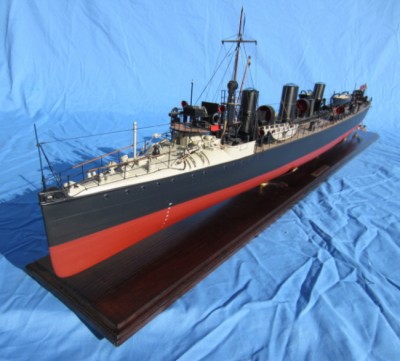
- HMS Velox at 1/48th scale. No WT gear was fitted when she was launched, hence she just has a signal mast.
-
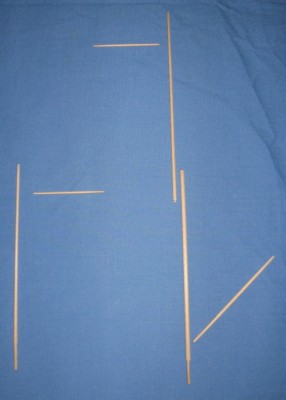
- The basic mast components for the two masts on V105. These are made from red cedar.
-
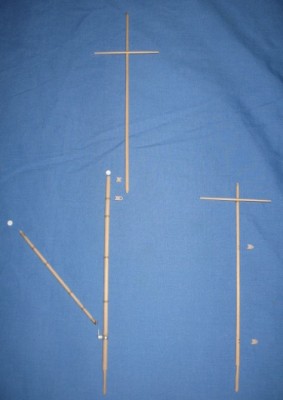
- The smaller components for the mast assemblies. The small white discs are the pulley sheaves.
-

- V105 in its storage/transportation box. The masts and rigging (WT aerials) show up a little clearer. The arrows indicate the points where the rigging unhooks.
Hi all
As the painting of the model reached its conclusion, I started on the mast construction. The masts were installed very near the end of the build for obvious reasons. They are strong enough to stand any normal use on the water, but it is very easy to get things hooked round them and do a lot of damage, plus they get in the way during the painting.
This model was the first I had built that depicted radio (WT) aerials, so I had to think how this �cobweb� could be partly disconnected to allow the removable deck section to be lifted off.
My previous model HMS Velox was built as launched, and at that time (1904), communicated via flag signal, so the small mast and associated rigging did not present a problem.
I decided that the aft mast on V105 would be fixed in the deck and stay there on the model. This was stepped into a section of aluminium tube secured in the non removable deck section. The smaller forward mast, stepped just aft of the bridge, would be glued in place the same way, but would obviously lift off with the bridge and removable deck section. All rigging to the forward mast therefore had to be either self contained within the removable section or be disconnected from the rest of the model.
The masts and spars were made up from some light, straight grained and strong �Western Red Cedar�. These were run up on the miniature circular saw, then carefully planed (with a finely set miniature block plane, flat on the work bench) first into a round cross section, then given the appropriate taper. They were finished with fine sand paper. The pictures show the mast components during manufacture.
The picture of V105 in its transportation/storage box gives a light coloured background so the rigging is easier to see. The arrows indicate where the rigging unhooks.
More on masting and rigging next post.