by MPERRY » Sun Apr 08, 2018 1:04 pm
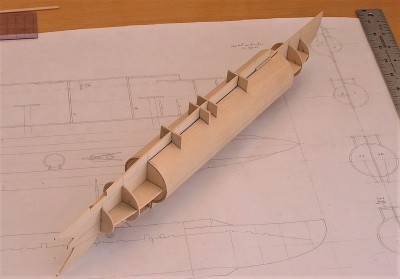
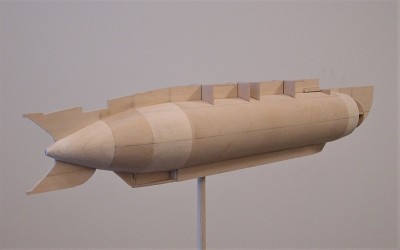
This project covers a model I made over 3 months during 2007. It represents a British X-Craft, X-5 Series. These were built in 1942 and used to damage the German battleship Tirpitz in 1943. They had an overall length of 51 feet 7 inches (15.7 meters) and a hull diameter of 5 feet 9 inches (1.75 meters). I chose to model these craft without the external saddle charges, that were attached on each side and dropped under the anchored target.
My primary reference was the book Midget Submarines, by Paul J. Kemp. The internet provided images to help me visualize some of the details, and just how tiny they were.
The primary material I used was 1/16 inch bassword, with laminated solid blocks at the stem and stern cone. The various linkages and net guards were wire. The two hatches and the combination air induction and voice tube were styrene.
The third image shows a piece of hull plating drying after being bent over a frame. This allowed the cylindrical amidships hull to be plated with a single sheet on each side.
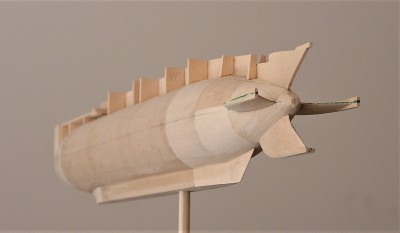
I used a Dremel etching bit to drill the many free-flood holes in the upper and lower casings. The bit ended up being the raised search periscope shown in some of the pictures. It was the perfect shape, diameter and length.
- Attachments
-

-

-

-

-
-

-
-

-

-
[color=#000000]This project covers a model I made over 3 months during 2007. It represents a British X-Craft, X-5 Series. These were built in 1942 and used to damage the German battleship Tirpitz in 1943. They had an overall length of 51 feet 7 inches (15.7 meters) and a hull diameter of 5 feet 9 inches (1.75 meters). I chose to model these craft without the external saddle charges, that were attached on each side and dropped under the anchored target.
My primary reference was the book Midget Submarines, by Paul J. Kemp. The internet provided images to help me visualize some of the details, and just how tiny they were.
The primary material I used was 1/16 inch bassword, with laminated solid blocks at the stem and stern cone. The various linkages and net guards were wire. The two hatches and the combination air induction and voice tube were styrene.
The third image shows a piece of hull plating drying after being bent over a frame. This allowed the cylindrical amidships hull to be plated with a single sheet on each side.
I used a Dremel etching bit to drill the many free-flood holes in the upper and lower casings. The bit ended up being the raised search periscope shown in some of the pictures. It was the perfect shape, diameter and length.[/color]