Page 2 of 4
Re: Scratchbuilding a WW2 USCG 83' Cutter in 1/24
Posted: Wed Sep 15, 2010 11:22 am
by Bill Waldorf
Hello again Dave, I like that cutter your friend made! Very Nice and does look good on the water. Can you find out where he got those figures......Thanks...
Re: Scratchbuilding a WW2 USCG 83' Cutter in 1/24
Posted: Wed Sep 15, 2010 11:56 am
by Dave Wooley
Bill Waldorf wrote:Hello again Dave, I like that cutter your friend made! Very Nice and does look good on the water. Can you find out where he got those figures......Thanks...
Sure no problem

Dave Wooley
Re: Scratchbuilding a WW2 USCG 83' Cutter in 1/24
Posted: Wed Sep 15, 2010 4:10 pm
by ingura
....
Re: Scratchbuilding a WW2 USCG 83' Cutter in 1/24
Posted: Thu Sep 16, 2010 7:34 am
by Ticonderoga
Really enjoying the build and the learning experience Bill, thank you.
Re: Scratchbuilding a WW2 USCG 83' Cutter in 1/24
Posted: Fri Sep 24, 2010 11:55 am
by Bill Waldorf
Hello again all

Work continues on the 83 footer.....Read on
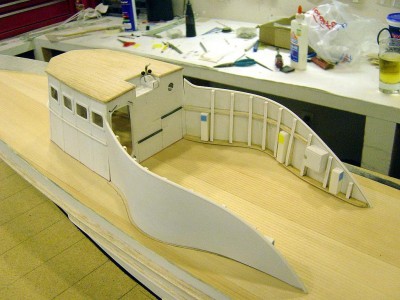
- View of the spray shields from port side. First order of business was to form the base of the shield. This was fabricated from 1/8" aircraft plywood using a pattern I made directly from the plans to get the correct shape. The shields are an odd structure. Lots of compound curves. Once the bases were completed, I formed the actual shields from 1/32 veener. This piece was then sandwiched between a layer of .015 styrene on the outside, and .010 styrene on the inside. The shield was then attached to the base, angling in slightly to conform with the pilothouse. Next, the horizonal braces were made with 1/16" balsa and the capped with 1/8" x .010 styrene. I then added the cross bracing which is 1/8" balsa stick. Next, a cap was added on the top edge of the shield using 1/16" styrene rod. Lastly, I added the vents and other items using balsa wrapped with styrene. Small colored squares on vents are vac formed louvers I made.
.....

- I have added the deck planking which is 1/32" scribed basswod. This was overlaid on the previously fabricated 1/16' balsa deck, using hi-strength contact cement. Note the spray shields.
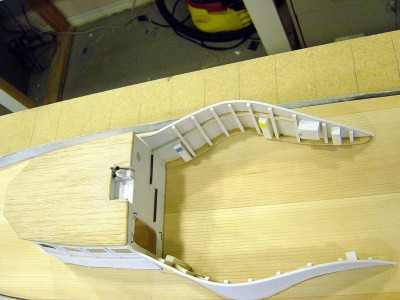
- Overhead view here. Pilothouse, shields and deck are all dry fit for now. Small box you see on the right is signal gun compartment.
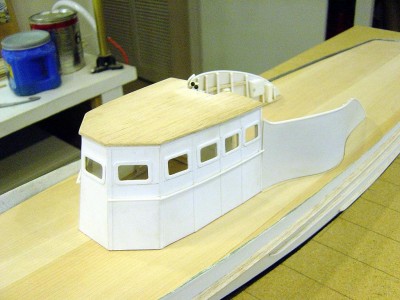
- View from portside.

- View from stb. Note rub rails or guards nearing completion.
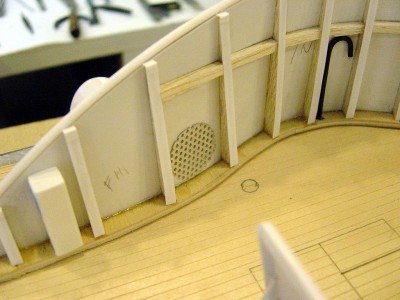
- Here more details added. Scuttle grating made from perforated aluminum. Gooseneck vent for officers toilet made from wire. There are three scuttles on the deck, 2 aft and 1 fwd. During hot weather, the scuttle plate was removed and the grating put in its place to help circulate fresh air through the boat.
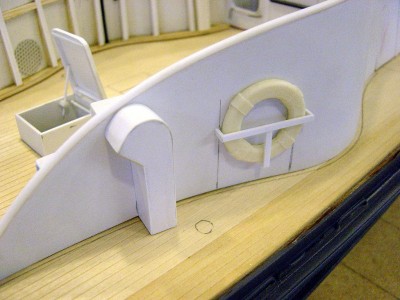
- More details added here. Life preserver is cast resin. The holder is styrene strip. Vent you see is engine room blower exhaust, made from balsa block and again wrapped with thin styrene. They had to run the exhaust blowers for engine room for at least 10 minutes, except in emergency situations. Note the forward engine room hatch, open.

- Another view here, portside. Again note fwd. engine room hatch, open. There is another one further aft.

- Close up of the fwd. engine room hatch. Made again from styrene. The lid was vacformed, then support added inside.
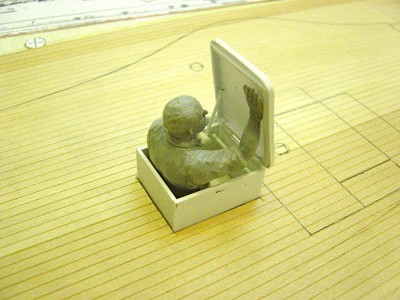
- The boat will be waterline with figures. Heres our engineer coming out of engine room. Modified racing car pit crew figure.
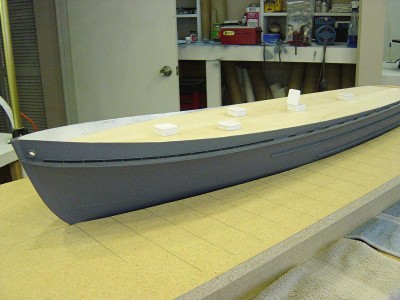
- All rub rails now completed and I have added the scupper openings and anchor hawses. Hull has been sanded and primed. All deck hatches installed.
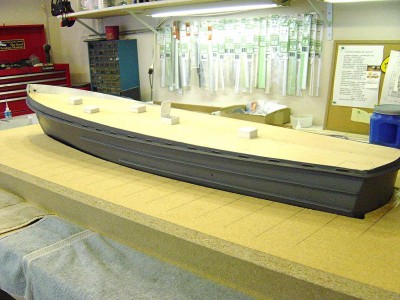
- Another view here from port. Small hole in side of hull is generator discharge, both sides.
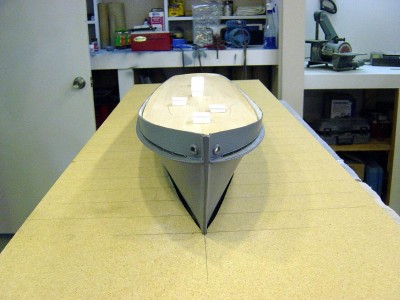
- Bow-on view. Anchor hawses are vacformed.

- Engine exhaust pipes, 1/4" aluminum tubing. A small support ring will be added around the pipes.
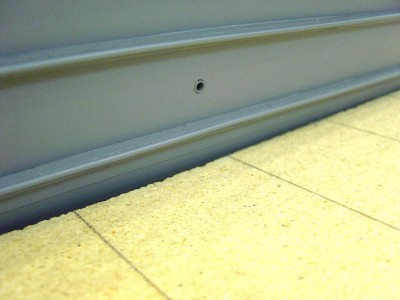
- Generator discharge outlet. Small gas engines drove generators. 1/8" alum.tube used here.

- Overall view from stb. of progress so far.
Well, there you have it......another update. Starting to look like a patrol boat. 1/24 scale is big compared to 1/96. A learning curve for me. Not much room for error.....Stay tuned.....More to come.....I continue on..........
Re: Scratchbuilding a WW2 USCG 83' Cutter in 1/24
Posted: Fri Sep 24, 2010 2:21 pm
by johndon
Beautiful work as usual Bill
John
Re: Scratchbuilding a WW2 USCG 83' Cutter in 1/24
Posted: Fri Sep 24, 2010 2:52 pm
by roy allen
you have been busy Bill, as always top notch workmanship
Love the curved spray shields

Roy
Re: Scratchbuilding a WW2 USCG 83' Cutter in 1/24
Posted: Fri Sep 24, 2010 3:17 pm
by 109
Superb!
Re: Scratchbuilding a WW2 USCG 83' Cutter in 1/24
Posted: Fri Sep 24, 2010 4:06 pm
by Ticonderoga
Excellent work and most interesting to view, thanks.
I like the idea of styrene over balsa for some of the complex shapes.

Andrew
Re: Scratchbuilding a WW2 USCG 83' Cutter in 1/24
Posted: Sat Sep 25, 2010 1:36 am
by Celestialsphere
Great work Bill,
I like those sinous curves of the spray shields.
Cheers
Andrew
Re: Scratchbuilding a WW2 USCG 83' Cutter in 1/24
Posted: Sat Sep 25, 2010 2:49 am
by DrPR
Bill,
Have you posted anything about how you vacuum form parts?
Re: Scratchbuilding a WW2 USCG 83' Cutter in 1/24
Posted: Sat Sep 25, 2010 3:37 am
by Dave Wooley
"Master craftman at work"
Bill your dedication to the craft and your ability is once again shown for all to see. How you build so quickly and accurately is amazing .
Dave Wooley
Re: Scratchbuilding a WW2 USCG 83' Cutter in 1/24
Posted: Sat Sep 25, 2010 9:49 am
by Bill Waldorf
DrPR wrote:Bill,
Have you posted anything about how you vacuum form parts?
Gee.....You know, I have not. I should probably do that. I'll put it on my to do list....Thanks for asking.
Re: Scratchbuilding a WW2 USCG 83' Cutter in 1/24
Posted: Sat Sep 25, 2010 9:55 am
by Bill Waldorf
Dave Wooley wrote:"Master craftman at work"
Bill your dedication to the craft and your ability is once again shown for all to see. How you build so quickly and accurately is amazing .
Dave Wooley
Thanks Dave.....I'm out of work till the end of the month, so rather than do housework, I build. Been doing 12 hour days on this thing. Not alot to go on with this one so alot is best guess scenario. Thanks to my customer, who was on board during WW2, I have got alot of info. But as usual, there is always a piece missing. A ways to go yet, but it is coming together. I'm not really sold on these fibreglass hulls either. As I said, a new learning curve. How is Kiev coming along???
Re: Scratchbuilding a WW2 USCG 83' Cutter in 1/24
Posted: Sat Sep 25, 2010 3:27 pm
by JIM BAUMANN
ah...
>> doing 12 hour days <<
that will help!!!
EXCELLNET MODEMAKING!
following with interest!
JB
Re: Scratchbuilding a WW2 USCG 83' Cutter in 1/24
Posted: Thu Oct 07, 2010 8:45 am
by Bill Vernon
My father, Al Vernon, was the CO of CG 28 at Normandy. He was rightfully very proud of his Coast Guard service; I wish he was alive today to see your great model of the 83. I do have a set of engineering drawings of the 83 if they would be helpful to you. I will be out of town until 10/11/10but feel free to contact me at
Bvernon@cbanker.com.
Re: Scratchbuilding a WW2 USCG 83' Cutter in 1/24
Posted: Thu Oct 07, 2010 11:15 am
by Dave Wooley
Bill Waldorf wrote:Dave Wooley wrote:"Master craftman at work"
Bill your dedication to the craft and your ability is once again shown for all to see. How you build so quickly and accurately is amazing .
Dave Wooley
Thanks Dave.....I'm out of work till the end of the month, so rather than do housework, I build. Been doing 12 hour days on this thing. Not alot to go on with this one so alot is best guess scenario. Thanks to my customer, who was on board during WW2, I have got alot of info. But as usual, there is always a piece missing. A ways to go yet, but it is coming together. I'm not really sold on these fibreglass hulls either. As I said, a new learning curve. How is Kiev coming along???
Hi Bill I To be perfectly honest like you I much prefer to scratch build the hull from the keel up . I had to do to much jig sawing and chopping up the Kiev hull before I was convinced it was usable. I have only once built on an accurate GRP hull and that was HMS Mersey , that hull was spot on. I guess it is all down to the making of the plug , accurate plug accurate mould, accurate hull . There are certainly lots of advantages for the R/C modeller , bag of access and easy to set up the running gear., batteries , ballast etc but the bottom line is you are doing what you have been asked to do to the very best of your ability and you really can't ask better than that. As for Kiev well , have you ever climbed a set of hills and you think you have just approached the summit only to find there is another summit beyond that well that's Kiev in a nut shell , but it will be completed come hell or high water !!!!!
Dave Wooley
Dave Wooley
Re: Scratchbuilding a WW2 USCG 83' Cutter in 1/24
Posted: Thu Oct 07, 2010 4:39 pm
by Ticonderoga
My Tico Hull finally arrives today so I will be able to directly compare, working with a pre-prepared hull verses working with my own scratch built hull.
Regards,
Andrew
Re: Scratchbuilding a WW2 USCG 83' Cutter in 1/24
Posted: Mon Oct 18, 2010 9:36 pm
by Bill Waldorf
Hello again all!
Work continues on the 83. Now that the pilothouse and shields are fabricated for the most part, I decided to move on to some of the weapons carried aboard. Namely, the depth charges and racks and the 7.2" rocket projectors, commonly known as "mousetraps". More work has been done on the pilothouse as well as the rest of the boat, so lets take a look..............

- Here is one of four depth charge assemblies. There is one port and one stb. about midships, and two aft. These were fabricated from various sizes of strip and angle styrene, utilizing photos and drawings as a guide. The charges are cast resin from "Macs Mouldings" of the UK. Cable stays are thin steel wire. There are 53 parts to each assembly. This is one of the aft racks.

- Another view here. Note the wrench hanging from small chain. This was used to set the detonation depth for the charges. Also note the extension to the right of the main rack. These folded up during normal operations, and were lowered for an attack run so charges would clear the hull.

- The aft racks in their relative position. Again note the extensions.
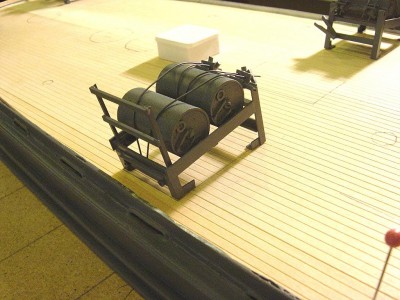
- Rack on stb. side. It will be closer to the bulwark at final installation. Note the extension now in the up position.

- An overall view of the depth charge arrangement, again in their relative positions. All four racks are basically the same, except for the position of the extensions. Note the slight deck camber.

- A shot of the 7.2 rocket projectors. Let me give a brief rundown on these........At the beginning of WW2, the standard anti-submarine weapon was the depth charge. One useful development for this type of weapon were called "projectors" - devices which could throw a pattern of depth charges ahead of the attacking ship, thereby avoiding the time lapse between the detection of a submarine at some distance and the actual attack.The US Navy's standard projector was the "Hedgehog" from 1942 onwards. This was reasonably effective, but the large recoil prevented its use on smaller craft, I.E., patrol boats. The solution was a rocket propelled depth charge. Enter the Mousetrap. this was a standard hedgehog charge fitted to a 2.25" solid propellant rocket motor. The name "mousetrap" was derived from the launcher, which was simply four steel rails mounted at a fixed angle, about 2 degrees, to the ships deck. The rails were raised or lowered manually. On small craft this system was used until the end of WW2. Range was about 300 yards. Photo shows assemblies pretty much finished. A bit more fine tuning on the rockets themselves.

- Heres the three main parts to the assembly. On the left the rocket ,not completed. Middle shows the rails and to the right is the rail frame. All styrene used here.
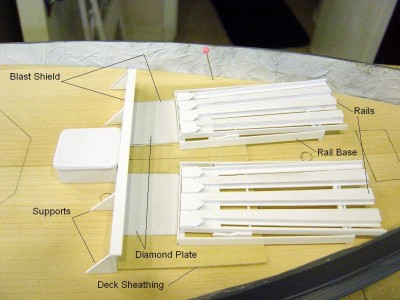
- Heres a breakdown of the further assembly. Note the rails in their lowered position.
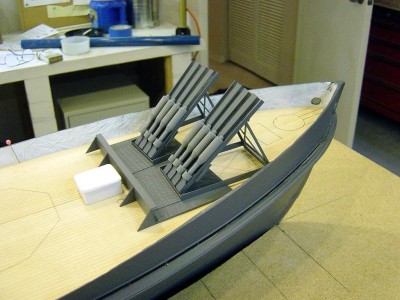
- Another look at the completed unit.
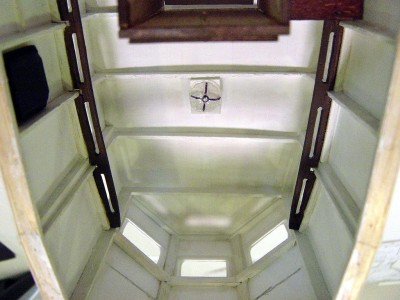
- More details added to the inside of the pilothouse. I have added grabrails made from 1/16" balsa, and the cabin light which was vac-formed from the head of a upholstry tack. Black box to the left is a heater.
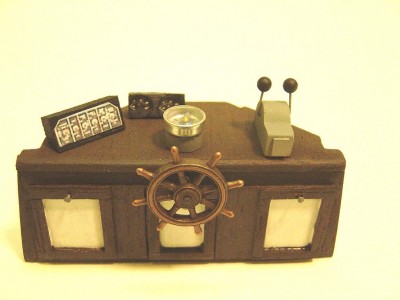
- The 'bridge" inside the P/H. Cabinet is balsa. Wheel is a brass casting. The guages and controls are made from aircraft inst. panel photos I reduced in size to fit. Compass is real! Knobs on doors are just sewing pins.

- Heres a breakdown of things.
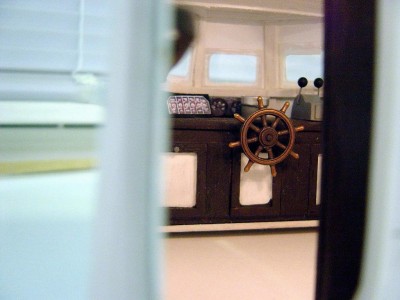
- Inside bridge now mounted. This view is looking through w/t door on P/H. I have added lights to the inside to see things better when replica is displayed.
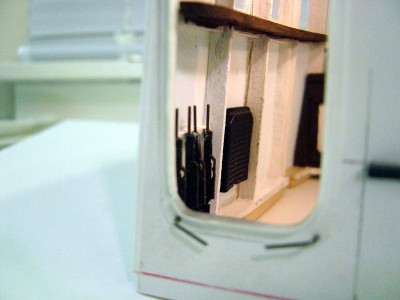
- Machine gun rack added next to heater.
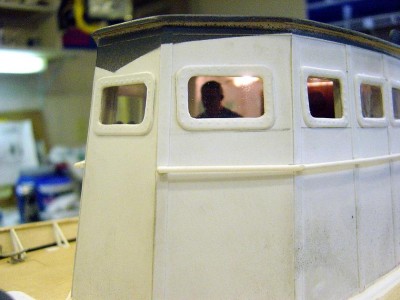
- Crewman now inside P/H.

- Note the grey hatch here. This is inside the pilothouse. Placement of this and the crew figure was a bit tricky as the p/h goes over the top of this. Note railing and safety chain. I have added 1/16 balsa to cover the rough fibreglass on the inside of the bulwarks. Also added the bracing for the bulwark from strip styrene. Note the fwd scuttle with grating installed instead of "manhole" cover to facilitate airflow.

- All bulwark supports now installed as well as the bulwark cap. Here you can see the relative positon of the mousetraps. I have also added the winch, some vents and other details.

- A close up here of the bow area. Small T is a scuttle plate wrench, to the right of that is the winch handle, they were manually operated. Also added hawse lips and skid plates for anchor lines. Forward jackstaff is turned brass. Scuttle grating is perforated aluminum.
Well, thats it for this update! Things are moving along. Stay tuned......More to come....I continue on...........
Re: Scratchbuilding a WW2 USCG 83' Cutter in 1/24
Posted: Tue Oct 19, 2010 3:34 am
by Dave Wooley