Page 2 of 6
Re: SOLFERINO 1861: French Ironclad in 350th and 700th
Posted: Wed Aug 24, 2011 7:43 am
by Filipe Ramires
Will be following this one closely. I was/am considering doing the frames of a submarine in this fashion. Time to take out my note book! Please professors do carry on with the stunning work!!!


Re: SOLFERINO 1861: French Ironclad in 350th and 700th
Posted: Wed Aug 24, 2011 8:31 am
by Dave Wooley
Hi Callen the word quality of build springs to mind , amazing workmanship, just amazing


Dave Wooley
Re: SOLFERINO 1861: French Ironclad in 350th and 700th
Posted: Wed Aug 24, 2011 3:33 pm
by Cadman
All you need now is some interior detailing.
Re: SOLFERINO 1861: French Ironclad in 350th and 700th
Posted: Wed Sep 07, 2011 6:02 pm
by callen
Dave Wooley wrote:Hi Callen the word quality of build springs to mind , amazing workmanship, just amazing
Dave Wooley
Thank you Dave! Most kind. There is certainly a lot to inspire one's best efforts on this board.
Filipe Ramires wrote:Will be following this one closely. I was/am considering doing the frames of a submarine in this fashion. Time to take out my note book! Please professors do carry on with the stunning work!!!
Hey Filipe! Good to hear from you. Please let everyone know if you start that Submarine.

Cadman wrote:All you need now is some interior detailing.
If I was scratching this from styrene, I might actually attempt a gun-deck or two, but since the whole point of this is a resin master, I have to 'keep it (relatively) simple.' Thanks for stopping by Tim.

Re: SOLFERINO 1861: French Ironclad in 350th and 700th
Posted: Wed Sep 07, 2011 6:19 pm
by callen
At the request of the La Rochelle Office, I chose to start on the 700th scale version, as Bruno is thinking about whipping one up for Telford... He gave me until the end of September!

Actually I think I might
just be able to pull it off. Here is the progress so far. Starts out looking almost exactly like the 350th scale version, except it's 1/4 the size.
Due to the arrangement of the hatches in the weather deck, it was necessary to cut away some of the interior of the frame plates. This is something I neglected to do with the larger model, and (I fear) may give me trouble later. I used sheet metal sheers to do this, and it worked well, although they were so large it was hard to control the cutting, and in one instance I cut completely through the outer edge of the frame. You can see this one is bent out of shape from the treatment. All of them required re-flattening, but this wasn't any big deal.
Bow section...
note penny for scale. Compare that to the 350th version above... Big difference!
Putty!
I hate putty, actually. However, for a number of reasons, I felt this would be the best medium for filling out the hull. It proved troublesome, as you will see. You'll notice that the bow frames broke off as I began attaching putty to the frames. They were glued back in place later, but the hard steely medium of the frames, glued insecurely with super-glue to the waterline plate interacted with the soft and somewhat springy putty in unpredictable ways.
I found it more or less impossible to sculpt the precise shape of the hull sides from wet putty, so decided to 'oversculpt' the contours and then sand and file them down once the milliput had hardened.
Here you can see the results of my sanding/carving efforts on the port amidships, so far so good. There is a bit of gouging at the top edge, but nothing that can't be fixed with more putty. However, later on I was to run into more serious difficulties with the putty.
Re: SOLFERINO 1861: French Ironclad in 350th and 700th
Posted: Wed Sep 07, 2011 9:03 pm
by callen
Continuing to fill out the hull... Spacer blobs were needed to re-enforce the section plates for the putty that would form the sides of the hull.
Here is the bow after filling, sanding and shaping... I felt like it was looking pretty good at this point. I did my best to carve 'into' the curves a little bit so that they had a nice gentle concavity to them.
What Is That????


Even my daughters, who are way more warship-savvy than they ought to be, couldn't figure out what their dad was doing with the metal plates and the putty. I think it looks like a rotten meat canoe, personally.


This was the completion of the putty for the hull contours. Once again I 'oversculpted' so I could hopefully carve and sand the shape flush once the putty had hardened.
I hate working with putty.
Re: SOLFERINO 1861: French Ironclad in 350th and 700th
Posted: Wed Sep 07, 2011 9:27 pm
by callen
Now to carve away all that putty, and hopefully get a beautiful and shapely shape...
Ouch!!!
"Dull blades are more dangerous than sharp ones..." and btw putty will turn the former into the latter quicker than anything I know.

shaping the stern... the reddish hue is a personal DNA sample I spontaneously chose to donate to the project.

Ahhh... now we come to the crux of it. Do you see what has happened to the frame sections? They have been distorted by the pressure of the putty between them, and now, as a result are not only inaccurate, but asymmetrical... very bad form.


You can see that the end of the stern does not fit evenly beneath the deck plate. Also it seems too wide. I ought to be able to fix this by sanding/filing down the stern, but it will be an 'eyeball' situation, rather than working from the section plates. I'm beginning to think that, no matter how accurate or perfect the components you are working with, there is always a degree of 'eyeballing' that goes into any model.
Although the putty proposition did not go as well as I had hoped, I anticipated that I might have difficulties with it. (did I mention I hate putty?) As many of you know, there is a 2% shrinkage that occurs between the dimensions of a casting master and a resin copy of the master. (the cast will be roughly 2% smaller) Since Bruno did not mention enlarging the dimensions of his PE by 2% I suspect he created the parts at exactly 700th scale. I am going to use that 2% leeway to my advantage by laying styrene planks onto the exterior of the hull and then laying the armor plate on top of that. This will give the armor the appearance of being laid on top of the planking (as indeed it was) as well as giving the ship a nice planked texture in the unarmored areas, similar to my carrack models. In addition it will regularize and hide the defects in my putty carving etc. One thing I've learned in modeling is, if you're trying something new, try to take steps to hide your screw-ups if you are able to.
The next time I am able to assemble one of Bruno's magnificent PE skeletons, I will probably use a different method.
C'est la Vie!
Well that brings us up to date, although I will be working on Solferino 700th this week and week-end, so I will have more pics soon. Hope everyone is enjoying their projects. Happy Modeling!
Re: SOLFERINO 1861: French Ironclad in 350th and 700th
Posted: Thu Sep 08, 2011 2:59 am
by Dave Wooley
Re: SOLFERINO 1861: French Ironclad in 350th and 700th
Posted: Thu Sep 08, 2011 3:14 am
by EJFoeth
Re: SOLFERINO 1861: French Ironclad in 350th and 700th
Posted: Thu Sep 08, 2011 5:53 am
by JIM BAUMANN
>> Jim, are you listening? See now here I'm using another one of your tips, and I didn't even know it.
<<
YUP!!!
Its a most worthy subject indeed...
I am watching this fine step by step...
Personally I would have used high quality ( classic car! ) auto-body polyester filler for the voids-- faster and easy sand.
keep the it cool by reducing catalyst...
Full ship rigging in 1/700 is probably possible..
I have just finished Vlad Mon last night...
It is a slightly simplified version--though all braces and hoists are split with blocks
and it looks pretty cool - for a micro model!
viewtopic.php?f=59&t=64591
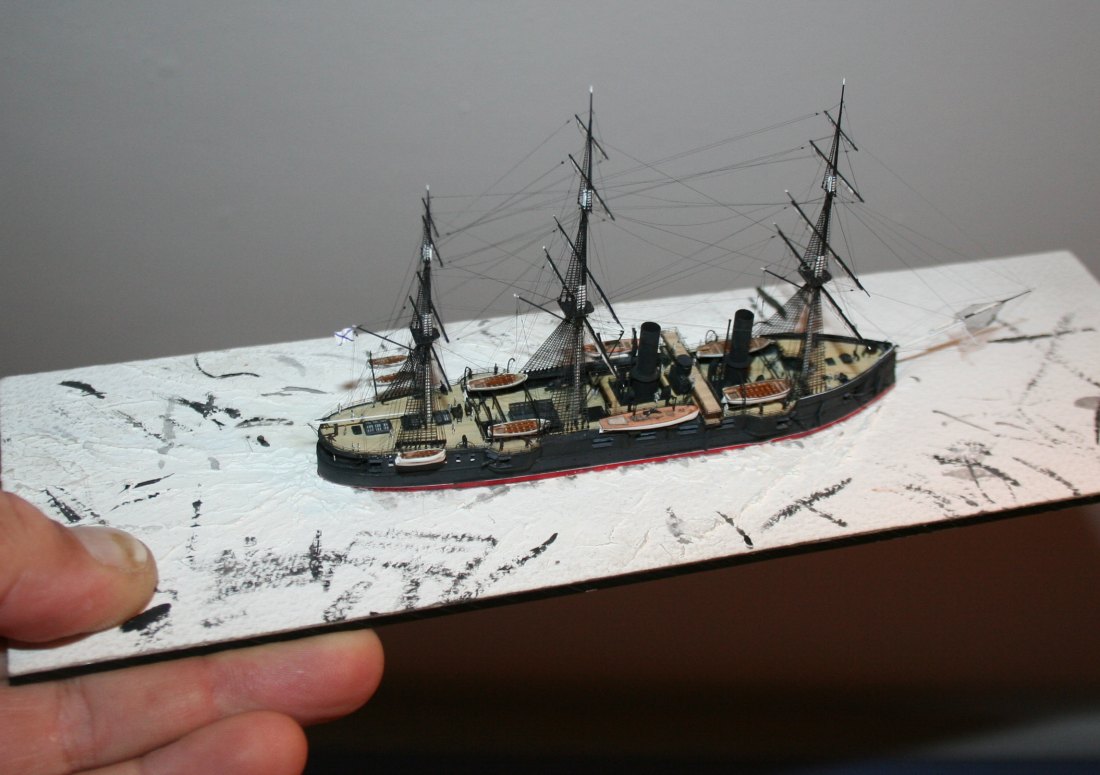
Foot ropes and sheer mass of vertical halyards were the trickiest
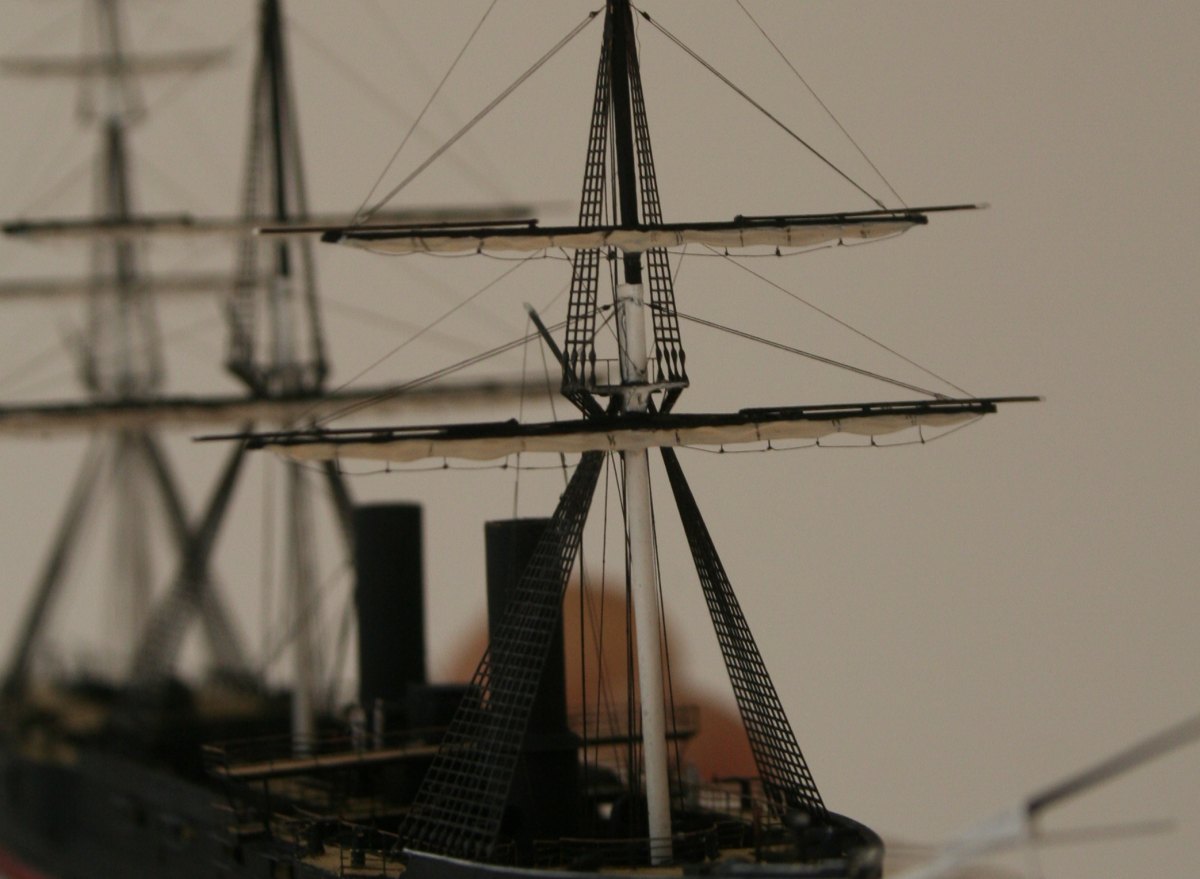
will update my thread shortly as it is now pretty much completed.
Cheers
JB
Re: SOLFERINO 1861: French Ironclad in 350th and 700th
Posted: Fri Sep 09, 2011 2:22 pm
by callen
Dave Wooley wrote:Brilliant methodology , superb .
Dave Wooley
Thank you Dave. I actually was a bit dubious about the methodology. However, since these last posts I've done some work on her and she is shaping up now. I was worried that the putty would be difficult to sand with the steel plates interspersed, but as it turns out they are perfectly sandable in combination. Bruno suggested I use some kind of construction board that he uses and gets great results with. However, in the event I chose to go with putty. I think I will do it differently next time. Modeling is a funny thing. You have to find what works for
you.
EJFoeth wrote:It's nice to see the progress and the problems you run in to. "next time", I'd design the sections at equidistant steps were you could just fit stock styrene strip between the frames. Than you could even let the styrene extend and sand away (more work?). I don't know how hard the etching material is and how much sanding it can take. I did something similar for very small hulls (not recommended for large hulls but might work with the etched framing. Here the stack of strip was just correct for a set of frames, add putty, sand until the putty is gone. It's stupid, but works. It's less risky than using that unforgiving milliput?
Dare I speculate those might be HMS
Hood boats in these pics?
That looks like a really great method for small scale. I'll have to remember that, EJ. Thanks for the pics. The etching metal is steel so it is very hard, but as I was saying to Mr. Wooley above when sandwiched in with putty (or probably any other reasonably solid medium) it sands fine. I gave the Solf. 700 a good sanding last night and she is now much more presentable. For a relatively small ship/boat though I think the styrene method you advocate would work really well. Miliput for me is not so much 'unforgiving' (you can carve it and sand it) as it is 'shifty' it doesn't stay put but can be springy, shrink back when you're trying to stretch it, and push other components out of joint when you're wanting it to stay put, etc. It is, however one of the preferred mediums for scratching in this scale, so maybe I just need to bite the bullet and get used to the stuff, I don't know.
JIM BAUMANN wrote:>> Jim, are you listening? See now here I'm using another one of your tips, and I didn't even know it. <<
YUP!!!
Its a most worthy subject indeed...
I am watching this fine step by step...
Personally I would have used high quality ( classic car! ) auto-body polyester filler for the voids-- faster and easy sand.
keep the it cool by reducing catalyst...
Goodness gracious! That VM is the best rigging job I have ever seen. Beautiful!!!

I wanted very much to use blocks with my
Fora carrack, and was taking steps in that direction, but the timing of the Nats blew that plan. I just couldn't bear the thought that after a year of working on carrack models I would have nothing to enter!
So I decided to complete her 'blockless' as it were. No one seemed concerned by the lack, but it was very evident in my mind.
On the subject of car putty... I thought about that, and actually have some, but I build in my living room in front of the TV with my wife and kiddos around, (I have a very understanding family
) so I try to keep a lid on the smelly stuff when I can. That's why I chose epoxy putty instead of auto-putty...
The
Vlad is such a great subject! I think also a VM would go great with the
Gloire,
Solferino and
Warrior on the shelves. They're all of the same basic vintage. I hope you don't mind me shamelessly aping the steps of your build when I get my own
Vlad.
Thanks for posting these pics Jim, and please send us a link when you've updated your thread.
Re: SOLFERINO 1861: French Ironclad in 350th and 700th
Posted: Fri Sep 09, 2011 2:52 pm
by bgire
Hi Neal!
My friend, I'm afraid you didn't fully catch my method...
I used construction board for the filling because this is SOFTER than the nickel alloy frames and it has NO shrinking effect.
Evergreen (styrene) filling also works fine but with a tendency to melt when sanded, requiring WET sanding.
Balsa wood also works.
I described this in detail in my Minneapolis/ Tulagi thread.
With construction board or Evergreen:
1- As it doesn't shrink the final block/ hull is fully accurate to the tenth of mm
2- As it is softer than the frames you have just to sand it, waiting for the "rattle" sound which tells you're arrived... without measuring.
With Milliput (I hate this product and bought it only once... in 1992) you can't do this correctly:
1- This epoxy compound shrinks down during curing, ruining the dimensional accuracy. It's a chance your hull didn't go the banana way!
2- Epoxy is harder than construction board or styrene and too close to the metal frames: when sanding the hull you won't hear that rattle sound and have to check, check and check again for not to sand too much and ruin each frame profile. This will be far more difficult. I hate checking and checking again when I can do better without... checking.
It's too late for your 1:700 scale hull, but please DON'T use Milliput or any epoxy compound filling in your 1:350 scale: I can guaranty you'll ruin it.
I can etch you a 1:700 replacement hull framing if you need one... Just ask!
_Bruno
Re: SOLFERINO 1861: French Ironclad in 350th and 700th
Posted: Fri Sep 09, 2011 4:29 pm
by callen
Bruno has surfaced!

Good to hear from you my friend.
Yes... I am afraid you are right about the miliput. I was aware you used different materials, but was not aware of the potential pitfalls of miliput. I have seen other scratch builders use it with success, notably Vlad Yakubov, so I felt it would be alright to use. I think the shifting of the frame plates must have occurred while curing, as I was very careful about alignment during the gluing and puttying process, etc.
However, all is not lost.

I will be posting more pics soon of the progress, but she is actually shaping up nicely now that I am not puttying anymore. I did some sanding of the shape to even out the imperfections. Both the sheer and camber of the deck seem to be preserved, and seem to be symmetrical. With the deck plate in place I think any imperfections in the horizontal plane will be corrected. The tumble-home and sheer in the vertical plane looks good as well. You might be weighing the options of whether to start a master over there at your end but wait until you see the pics!
I will have more soon.
Re: SOLFERINO 1861: French Ironclad in 350th and 700th
Posted: Fri Sep 09, 2011 4:37 pm
by bgire
I feel better....
Anxiously waiting for your pictures... I'm optimistic again
_Bruno
Re: SOLFERINO 1861: French Ironclad in 350th and 700th
Posted: Fri Sep 09, 2011 5:01 pm
by callen
While I've got you here... a quick question regarding deck details.
Centerline hatches, companionways, etc. I'm needing to know whether I need to create voids (interior spaces) for all of them or only for some of them, as I am fast approaching the point where I will be attaching the deck.
Beginning from the bow, and numbering each rectangular opening in the deck plate, I am aware from the plans that opening 3 immediately behind the foremast is a companion way and am planning to create steps down into the hull for it. However, can you tell me which direction the steps go? Also for opening 5 and 8? (I am counting the large opening between the mainmast and the mizzen mast with the narrow athwartships cross piece as a single opening.)
Secondly, what is the purpose of openings 1, 2, 7, 9 & 10? Do they need voids or will they be covered by detail, etc? There is small writings on the plans in these areas, but it is in French.
Re: SOLFERINO 1861: French Ironclad in 350th and 700th
Posted: Sat Sep 10, 2011 5:04 pm
by MichelB
Callen, as a alternative to Milliput (for projects to come) consider Magic Sculp, a two-component epoxy putty that - as far as I have known in half a dozen hulls and assorted other builds - doesn't shrink.
Re: SOLFERINO 1861: French Ironclad in 350th and 700th
Posted: Sat Sep 10, 2011 5:14 pm
by bgire
That's correct, Michel: I've been using Magic Sculpt for years. Its shrinkage is really negligible.
But the trouble with this sanding method is Magic Sculpt is too hard relative to the metal frames.
_Bruno
Re: SOLFERINO 1861: French Ironclad in 350th and 700th
Posted: Sat Sep 10, 2011 8:35 pm
by callen
Here we go!
So I got this wild hair idea to put the knife down and start
sanding the model... What do you think? And you know what? It was amazing! The sanding started to even out the imperfections of the carving knife! ...
Oops! Snap! the epoxy separated from the steel... But a little bit of CA in the joint and we were back in business.
I felt silly for not having tried this before...
Aft sheer looks pretty good... but amidships it's a bit dodgy. However the armor plate would help me to establish amidships deck line.
Re: SOLFERINO 1861: French Ironclad in 350th and 700th
Posted: Sat Sep 10, 2011 8:44 pm
by callen
By this point I felt like maybe I had pulled the model out of the fire. Between sanding and adding a layer of detail, I thought I might have a chance at a workable casting master after all... So I decided to proceed with the plan.
Laying the First Plank Line!
More planks...
The planks were laid a bit rough amidships, but I didn't worry too much about it since I knew the armor would completely cover this area.
Shaping the armor plate. Now that it had been annealed it was as soft as brass, but shaping the flat piece to fit the 3-d curves of the hull was still tricky...
Re: SOLFERINO 1861: French Ironclad in 350th and 700th
Posted: Sat Sep 10, 2011 8:59 pm
by callen
The starboard armor plate installed. Unlike the 350th version, this was all in one piece.
I began by gluing the amidships to the styrene planks. Lots of glue to ensure a good hold. I then did some final shaping to the ends. Very tricky to get the armor both bent to shape and lined up so that both ends met the perpendiculars without going short or overlapping. I was very pleased with Bruno's engineering once I was able to get it all installed. And that armor plate has the individual plates etch-relief exactly according to the original archive plans. If all goes well we will have an exquisitely detailed hull thanks to my French friend.
I hollowed out the gun ports beneath the armor by pulling up the plank styrene there, making them slightly deeper than they would otherwise have been.
Once or twice an insecure plank fell away between ports and had to be replaced. Which turned out to be a simple process and not at all difficult.
Later a mistake in cutting and aligning was solved by pulling up the planks between two ports and cutting new ones to shape.
Portside is as yet still untouched.
Bruno's PE window ports installed in their proper places.
I think it's shaping up. Nearly ready to tackle the port side. Then it will be on to the Deck, the bulwarks... and we will have a completed hull. Wish me luck, and happy modeling!

