
Well, this is the post I should have spent much time addressing and focusing my questions on. You obviously put a whole lot of time in on this, so I apologize for having asked questions you already answered in this and a few other posts.
--- Well, here seems to the the final answer to my question. The ballasting aft was too much to accomodate the deep VLS. Is the balasting anything that cannot be removed and replaced with the deep VLS cells?Michael Potter wrote:
In the original contract DD 963 design, which you see in USS Spruance and her earliest sisters as built (before USS Moosbrugger), the potential future update for air defense provided for the launcher configuration that existed on the DDG 993 and CGN 38 classes: 24-round Mk 26 Mod 0 forward, 44-round Mk 26 Mod 1 aft. The undersea warfare modernization option provided for a Mk 26 Mod 0 launcher forward.
--- So, does that mean that the later Spruances could not support the AAW conversion?
The original concept for VLS was to provide a plug-in successor to the Mk 26 launchers and magazines for "short" missiles only, within the same volume and utilities. The limitation for the DD 963 class would be that the total mass of the loaded VLS could not exceed the allowable mass of the Mk 26 launcher and its loaded magazine, since the Tartar-D system would put the modernized ship at its weight limits.
--- Is this to say that there was something special about the forward VLS pad in order to accept the deep cells to employ tomahawks?
If you have the weights of these various launchers and "short" missiles, which may exist in the early editions of Norman Friedman's World Naval Weapons Systems, you might be able to compute the potential number of loaded VLS "short" cells. Notice that the answer could vary depending on the mix among the different missiles. Suppose Missile X weighed 80% of Missile Y; then you could load qty 5 Missile X's in place of qty 4 Missile Y's. Since the short VLS would look the same from above as the actual Mk 41, for a model of a hypothetical DD 963 modernized for air defense you could on this basis legitimately show an aft VLS installation of the number of cells you estimate. Remember that a reload crane occupied the space of another three VLS cells per VLS, in this design.
--- Concerning this, would the aft VLS be limited to an arangement less than 61/64 cells such as 32 or 48, or would you still be able to have 61/64 just of a short/shallow cell?
--- Would the aft cells then be limited to the short missiles to which you refer?
Reagan's SecNav John Lehman put a high priority on Tomahawk, which had a nuclear version for launch in torpedo tube mode or box launcher mode. Tomahawk was a longer missile and required a deeper VLS than the VLS design for the "short" missiles. Lehman killed the VL-Harpoon to force the uniformed USN to accept his priority for the deep VLS, in order to support Tomahawk anti-ship missiles, and thus to support the naval Tomahawk program, about whose life prospects the uniformed USN was evidently dubious in the early 1980s.
sube. Whenlowading those missiles, a big rectangular box as you know, they have to be nearly perfectly nied up or else there are all kinds of jams that occur.
--- What is the difference between the TASM and the TLAM other than guidance package? Why can't the missile's brains just be swapped out from TLAM to TASM?
Three items here: 1, whether Lehman was really competing against the USSR or against the USAF, some other historian may evaluate. 2, IIRC neither a vertical-launch Tomahawk anti-ship missile nor a vertical-launch nuclear Tomahawk land-attack missile was ever developed, on Lehman's watch or ever since. 3, USN skeptics about Tomahawk could note that the USN nuclear Tomahawks were moved to storage ashore in 1989, the US Army nuclear Tomahawks or GLCMs were scrapped altogether, and the anti-ship Tomahawks were converted to conventional land attack.
The deep VLS became the Mk 41 VLS that went into USN service. Lehman did not think to tell the designers of the CG 52 series about how many Tomahawks to plan for when computing weights. The CG 52 ship designers, not operational planners, proposed 16 Tomahawks and 45 SM-2(MR)'s, which OpNav then authorized as the basis for naval architectural calculations.
The weapons community came up with an abortive antisubmarine weapon called Sea Lance, with VL-ASRoc, and with longer Standard missiles. All of these required the deeper VLS cells and increased the weight of the loaded VLS. The heavier missiles made the VLS reload crane so slow as to be useless for UnReps, since it was sized for the "short" missiles. The Standards required missile guidance systems aboard the launching ship (or aboard a ship data-linked to the launching ship, which USS Kidd and Scott actually tested in 1989, but was not implemented), which were never provided for the DD 963 class.
--- I heave heard on the other hand that the VLS crane was usless for unrepping missiles, because every time they tired to use it, the missile would swing all over the place, and they could never line the box up right with the tube. I did not realize that the strike-down module crane was fitted for short missiles such as the Sm-1. I was under the impression that the SM-1 was doomed as soon as the SM-2 and and VLS was put into the fleet. The SM-1 was simply too short of range.
believe that much of the ballasting of the DD 963s was to counterbalance the mass forward of the VLS if filled with Tomhawk land-attack missiles. It is for that reason that I doubt that mounting a deep Mk 41 VLS aft was a possibility for the DD 963 class; and only the deep VLS entered USN service.
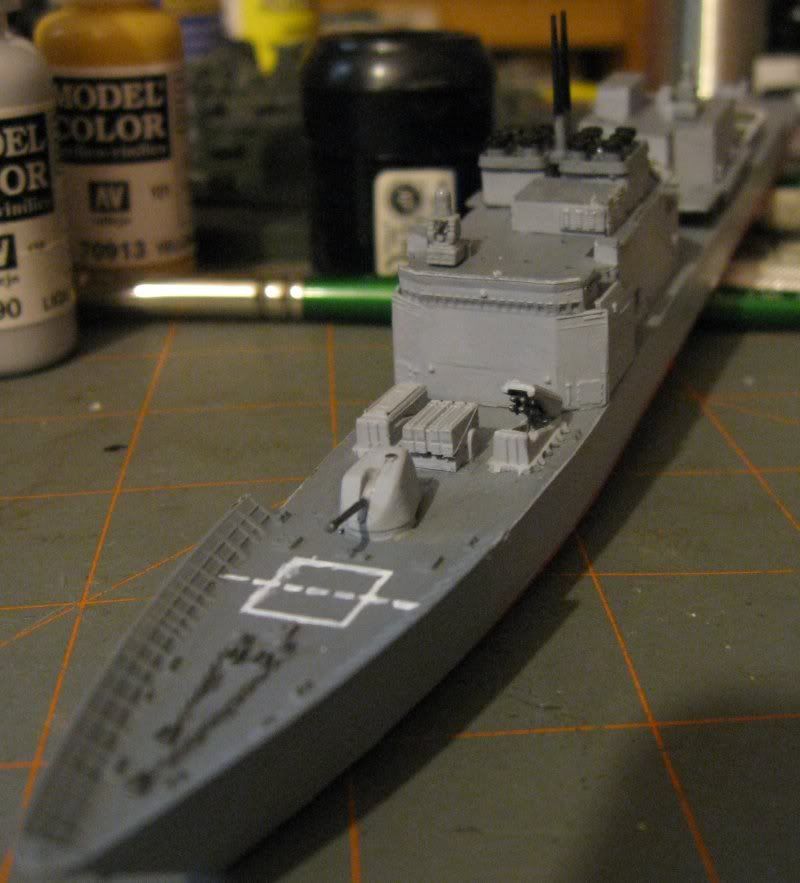
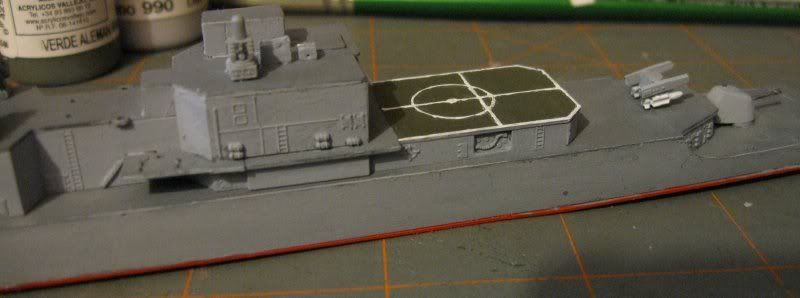
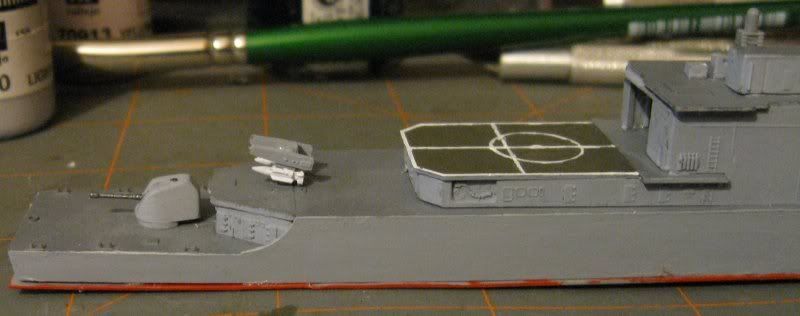



 I served on USS KIDD from 1983-1986, even before TICONDEROGA arrived in Norfolk. Those ships were great and packed a punch. We still had label plates in Farsi and there were Baxter bolts throughout the flight deck (which the USN covered over with the non-skid) to accommodate a large ceremonial awning. Later I was the Operations Officer (Overhaul Coordinator) on USS HAYLER 1991-1992 during her conversion. It was quite a re-work, the conversion the only decks not affected were the Sea Sparrow deck and the Harpoon deck. HAYLER was unique because she enjoyed many of the engineering improvements designed for the TICOs.