Normandie is a Compagnie G�n�rale Transatlantique transatlantic liner built by the Chantiers de Penho�t (now Chantiers de l'Atlantique) in Saint-Nazaire from 1931 and registered at the Port Autonome du Havre in 1935.
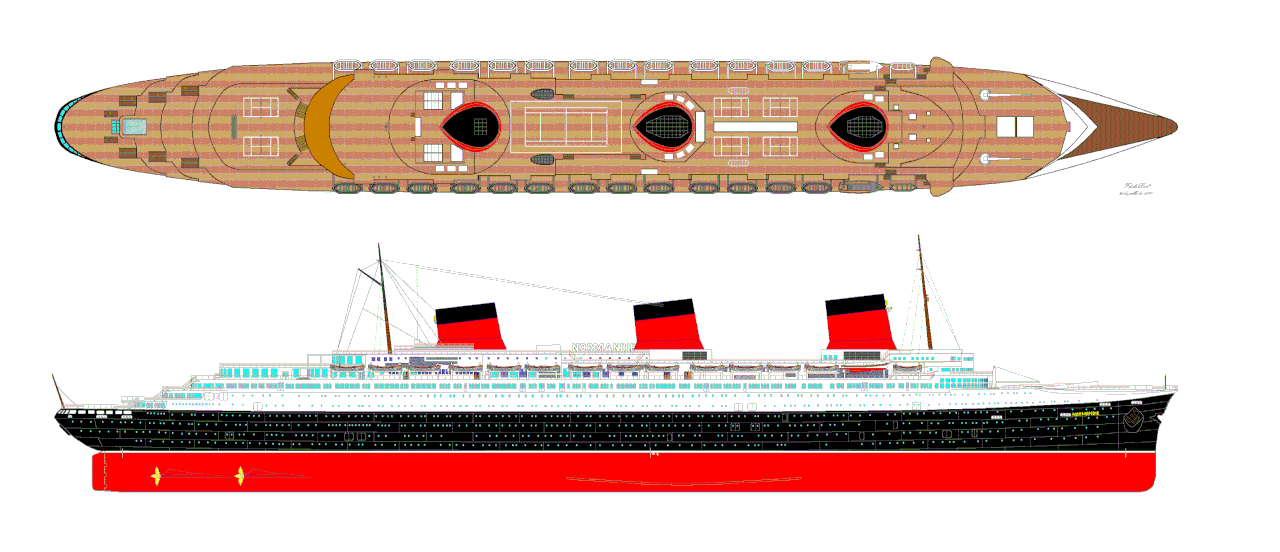
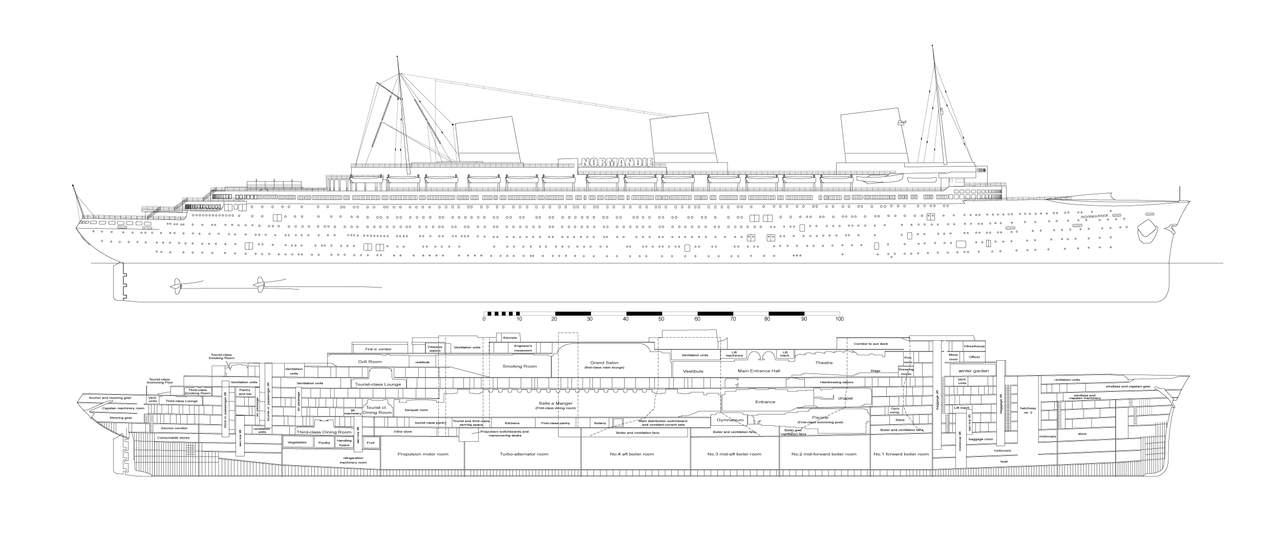
The project was launched in 1926, in close collaboration with the French government, as part of the obligations of the 1912 postal convention4 and as a continuation of the liners France, Paris and �le-de-France. The aim of the project was to provide France with a ship that was both large and fast. Work began on 26 January 1931 in Saint-Nazaire4, when the hull was named T6. The Great Depression slowed construction and the liner did not enter service until 1935.
When she entered commercial service, Normandie was the largest ocean liner in the world. Her maiden voyage was a major media event, covered in full by the French and international press. The ship was a complete success. It smashed the record for crossing the Atlantic and conferred immense prestige on France. Modifications were made in 1936 before the luxury liner entered into competition with its English rival, Queen Mary. The battle for the Blue Ribbon lasted two years and attracted worldwide attention.
Normandie's commercial career was marked by immense popularity with celebrities and extensive media coverage of her voyages. The liner was widely used by the French government for national propaganda purposes, telling the world that Normandie was the epitome of 1930s France.
However, Normandie's career was interrupted by the Second World War. The liner was decommissioned and remained docked in New York harbour. At the end of 1941, she was requisitioned by the United States and renamed USS Lafayette, to be converted into a fast troop transport. A supposedly accidental fire broke out during work on the ship in 1942. The tonnes of water used by the fire brigade caused the ship to capsize under the effect of the tide. After the war, France refused to recover the ravaged hull. The hull, reduced to a wreck, was demolished until October 1947.
Despite the brevity of her career (4 years), Normandie left a deep imprint on the world's memory. She is considered to be the most successful ocean liner in history. Her particularly sumptuous facilities mean that she is still considered to be the most beautiful and luxurious liner ever built. A true symbol of France's savoir-faire and art of living, its history is intimately linked to that of France in the 1930s. Appearing in a number of films, Normandie established an image of modernity and power that has long been associated with her era. Its decorative elements, dismantled and disembarked before the conversion work, have been placed in museums and private collections around the world. (Wiki fr).
Normandie
Other names T6 (construction)
Lafayette (1942 - 1946)
Type Transatlantic liner
History
Shipyard Chantiers de Penho�t, Saint-Nazaire
Keel laid 26 January 1931
Launched 29 October 1932
Commissioned 29 May 1935
Status Burnt down in 1942
Demolished in October 1946
Crew
Crew 1 345
Technical specifications
Length 313.75 m
Main beam 36.40 m
Draught 11.20 m
Displacement 70,171 t
Deadweight 14,420 t
Tonnage 79,280 grt (1935)
82,799 grt (1936)
83,423 grt (1937)
Steam propulsion, turbo-electric. 29 Penho�t water-tube boilers, four steam turbine - three-phase alternator sets (6000 V 81 Hz), four synchronous electric motors
Power 160,000 hp
Speed 32.2 knots
Commercial specifications
Deck 12
Passengers 1 9712
Career
Shipowner Compagnie g�n�rale transatlantique (1935-1941)
US Navy (1941-1946)
Flag
France (1935-1941)
United States flag (1941-1946)
Home port Le Havre
Cost 860 million francs
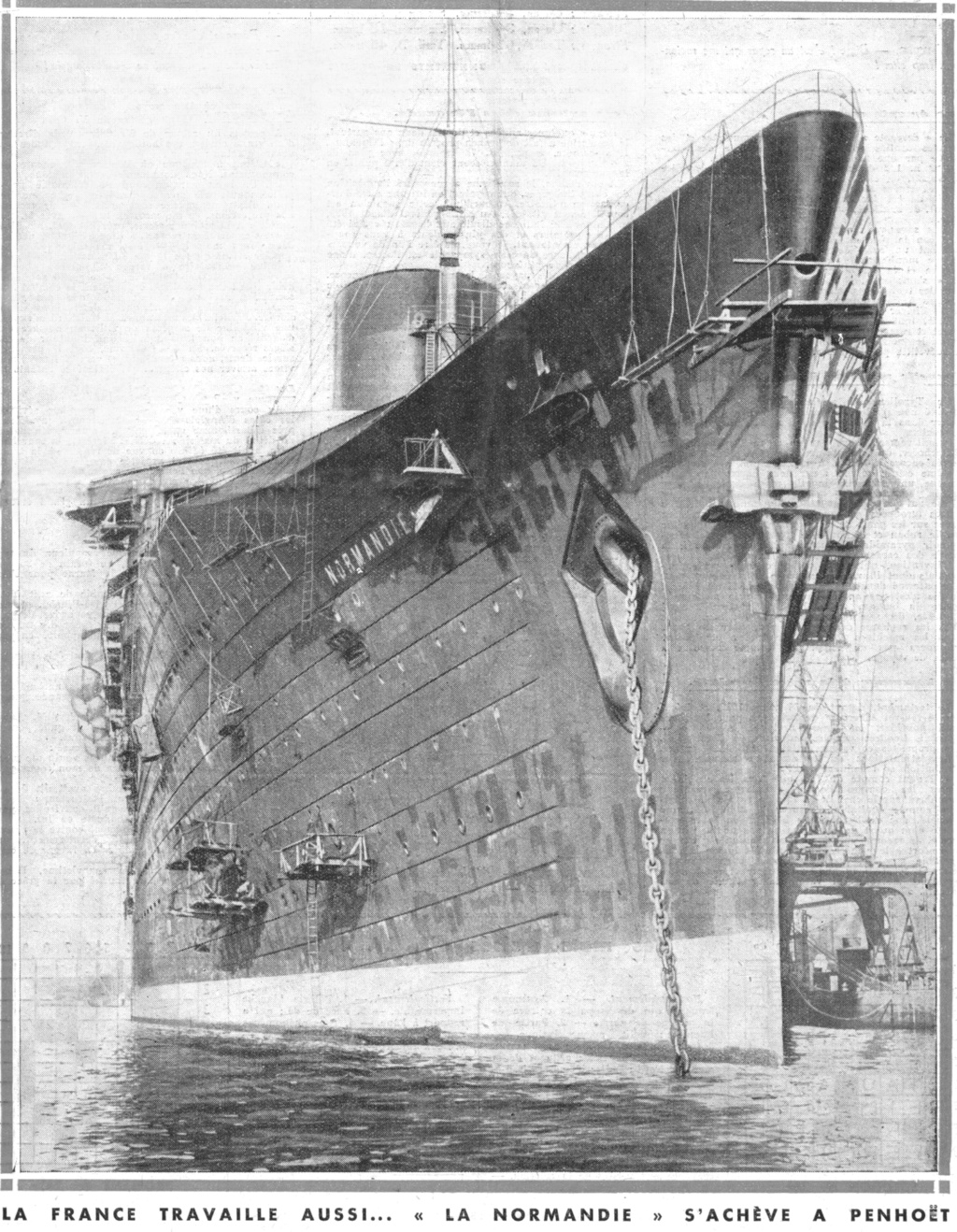
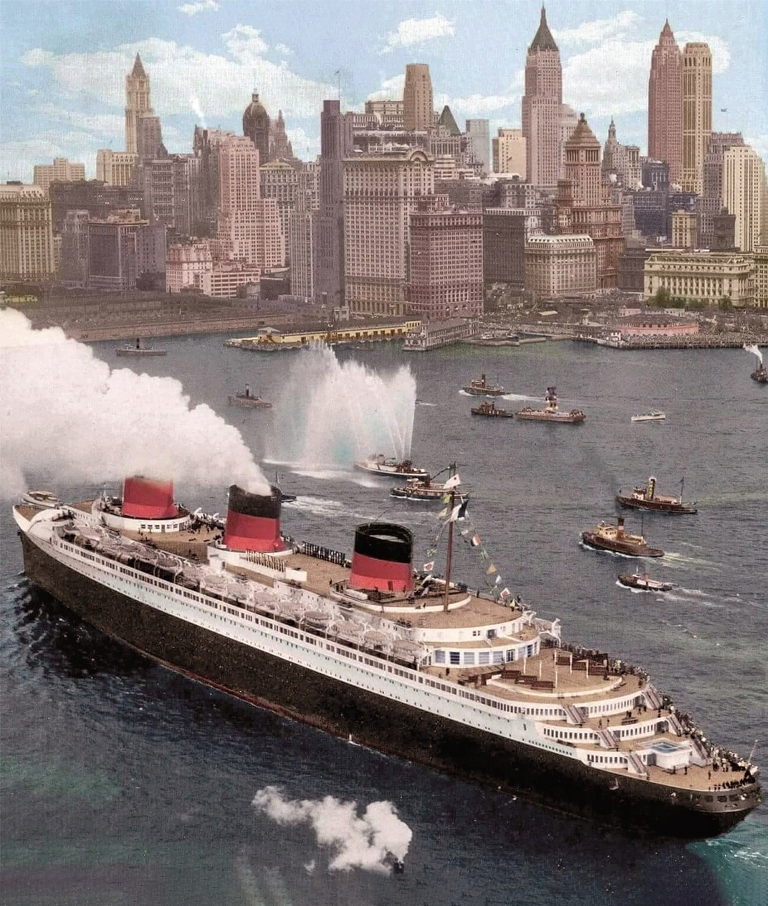
Normandie is a Compagnie G�n�rale Transatlantique transatlantic liner built by the Chantiers de Penho�t (now Chantiers de l'Atlantique) in Saint-Nazaire from 1931 and registered at the Port Autonome du Havre in 1935.
[url=https://postimg.cc/WdFwgr3M][img]https://i.postimg.cc/Mpt3kmJr/2560px-Normandie-deck-e-lateral.gif[/img][/url]
[url=https://postimg.cc/MvrYntW6][img]https://i.postimg.cc/P5dVFF9w/Ssnormandie-sideelevation-NYC.png[/img][/url]
The project was launched in 1926, in close collaboration with the French government, as part of the obligations of the 1912 postal convention4 and as a continuation of the liners France, Paris and �le-de-France. The aim of the project was to provide France with a ship that was both large and fast. Work began on 26 January 1931 in Saint-Nazaire4, when the hull was named T6. The Great Depression slowed construction and the liner did not enter service until 1935.
[youtube]dGqoT6isu18[/youtube]
[youtube]PweQFZbqTf4[/youtube]
When she entered commercial service, Normandie was the largest ocean liner in the world. Her maiden voyage was a major media event, covered in full by the French and international press. The ship was a complete success. It smashed the record for crossing the Atlantic and conferred immense prestige on France. Modifications were made in 1936 before the luxury liner entered into competition with its English rival, Queen Mary. The battle for the Blue Ribbon lasted two years and attracted worldwide attention.
Normandie's commercial career was marked by immense popularity with celebrities and extensive media coverage of her voyages. The liner was widely used by the French government for national propaganda purposes, telling the world that Normandie was the epitome of 1930s France.
However, Normandie's career was interrupted by the Second World War. The liner was decommissioned and remained docked in New York harbour. At the end of 1941, she was requisitioned by the United States and renamed USS Lafayette, to be converted into a fast troop transport. A supposedly accidental fire broke out during work on the ship in 1942. The tonnes of water used by the fire brigade caused the ship to capsize under the effect of the tide. After the war, France refused to recover the ravaged hull. The hull, reduced to a wreck, was demolished until October 1947.
Despite the brevity of her career (4 years), Normandie left a deep imprint on the world's memory. She is considered to be the most successful ocean liner in history. Her particularly sumptuous facilities mean that she is still considered to be the most beautiful and luxurious liner ever built. A true symbol of France's savoir-faire and art of living, its history is intimately linked to that of France in the 1930s. Appearing in a number of films, Normandie established an image of modernity and power that has long been associated with her era. Its decorative elements, dismantled and disembarked before the conversion work, have been placed in museums and private collections around the world. (Wiki fr).
Normandie
Other names T6 (construction)
Lafayette (1942 - 1946)
Type Transatlantic liner
History
Shipyard Chantiers de Penho�t, Saint-Nazaire
Keel laid 26 January 1931
Launched 29 October 1932
Commissioned 29 May 1935
Status Burnt down in 1942
Demolished in October 1946
Crew
Crew 1 345
Technical specifications
Length 313.75 m
Main beam 36.40 m
Draught 11.20 m
Displacement 70,171 t
Deadweight 14,420 t
Tonnage 79,280 grt (1935)
82,799 grt (1936)
83,423 grt (1937)
Steam propulsion, turbo-electric. 29 Penho�t water-tube boilers, four steam turbine - three-phase alternator sets (6000 V 81 Hz), four synchronous electric motors
Power 160,000 hp
Speed 32.2 knots
Commercial specifications
Deck 12
Passengers 1 9712
Career
Shipowner Compagnie g�n�rale transatlantique (1935-1941)
US Navy (1941-1946)
Flag
France (1935-1941)
United States flag (1941-1946)
Home port Le Havre
Cost 860 million francs
[img]https://i.servimg.com/u/f85/20/48/81/42/za_la_10.jpg[/img]
[img]https://i.servimg.com/u/f85/20/48/81/42/2-norm10.jpg[/img]