I found this on that USS Hector AR-7 veterans association site..........
It's the stack emblem for South Vietnamese Navy ship HQ-3 Tran Nhat Duat which was the former USS Yakutat AVP-32 and USCGC Yakutat WHEC-380 and was given to the RVN in 1971 like the Bering Strait was.
Thanks to vnaff for the link to this article which contained this great photo of the RVN cruiser HQ-3 Tran Nhat Dhat, formerly the USS Yakutat AVP-32 and USCGC Yakutat WHEC-380. It was a terrible time but, a terrific photo all the same.
I recognized the stack cap when I was on the Hector site and figured it was one of the transferred ships.
I think that's the key to getting photos of details... the reunion sites of other ships and the desired ship. You never know what is going to be in the background.
I just wondered what it would look like in B&W, rather than sepia or color. Would it look more like a WWII shot?
And playing with the lighting might have an interesting effect. In addition to diffusion, the angle of the light can also affect the picture because shadows change the scene. In color photography, the type of light can change color. Think of paint chips. They look one way under flourescent light but can be quite different in direct sunlight. Its just something else to play with, going beyond your great backdrops
That last one rally looks like it could have been taken during the war!!
Do you loose some detail? Yes
Like all operational (as opposed to shipyard) WWII photos, do you wish that more details were visible? Again, yes. But that's what adds to the realism!
Could yo do this with a less well made model? No.
That last one rally looks like it could have been taken during the war!!
Do you loose some detail? Yes
Like all operational (as opposed to shipyard) WWII photos, do you wish that more details were visible? Again, yes. But that's what adds to the realism!
Could yo do this with a less well made model? No.
Russ
............and yet some details now pop out that might have otherwise been overlooked, I think.
I attended the reunion dinner for the USS Duxbury Bay AVP-38, last month, in St. Louis, MO. My father served on the USS Duxbury Bay in 1952 and 1953.
I brought my 1/350 Barnegat Class models, with me, for the shipmates to enjoy; USS Duxbury Bay, USCGC Bering Strait, and USS Oyster Bay. I also brought shipyard plans for them browse over as well as photos that my father had taken while assigned to the USS Duxbury Bay.
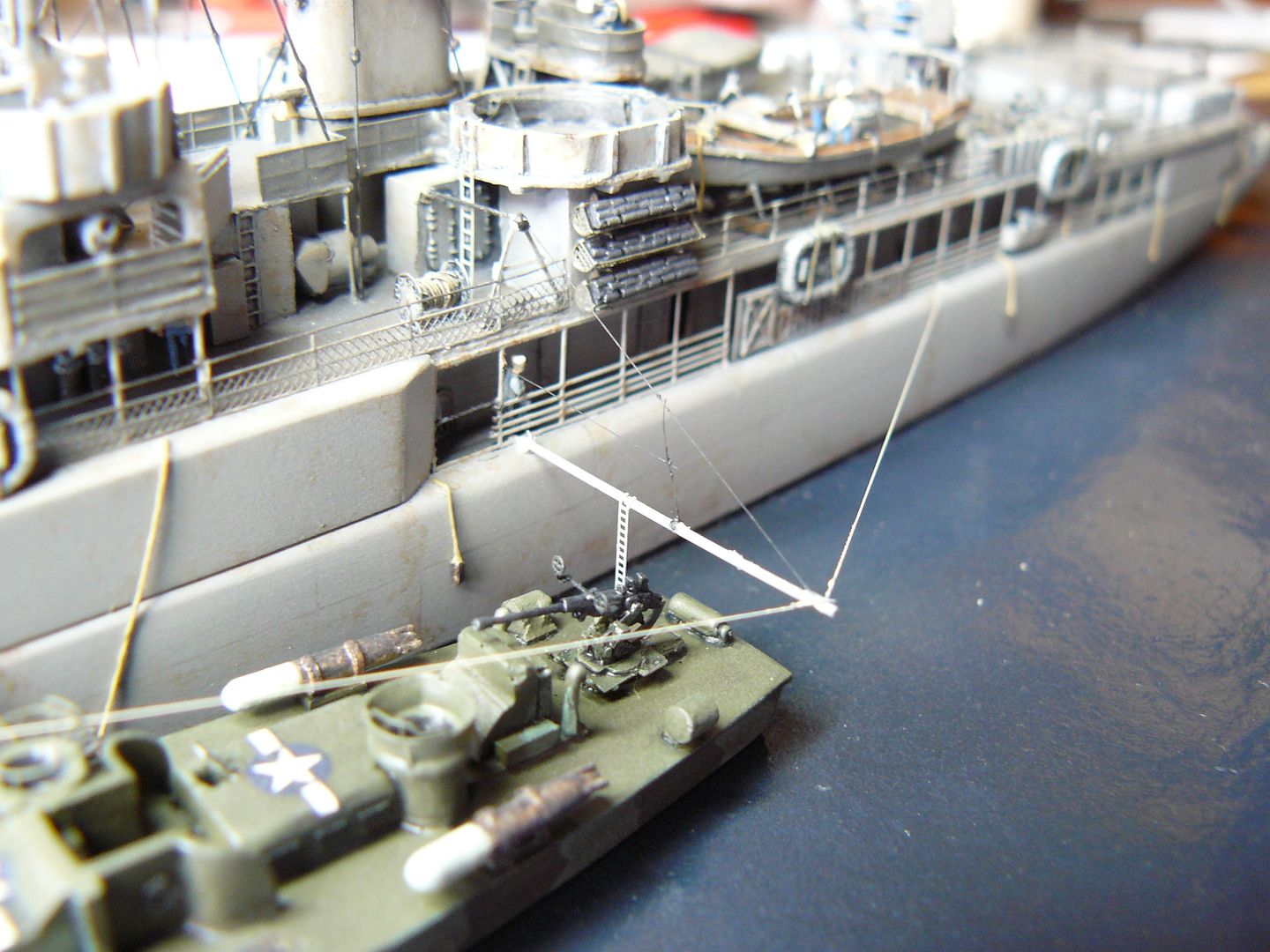
Well, I've made the plunge and attached the ship to the water base which I have re-painted and Futured, again.
And I've finished one 30' boat boom. There were six, total, on these AGPs; three on each side. I plan to deploy at least one more if not three total. Maybe one rigged part way out.
I wonder how long it will take me to bust this one off the model.
Russ2146 wrote:That is the most accurate boat boom rigging that I think I have ever seen.
Thanks, Russ.
It helps to have plans as well as photos. The AGP drawings that I have actually show two more stays on the aft side of the boom but, I think this was enough detail.
This entire boom may come off, though. The fore stay on the boom is interfering with the PT Boat's .50 cal rail and the boat's mast will be in the way of the fore stay when it goes on. I could, however, lower the boat's mast and put it in the stowed position. But, it makes me wonder why the AGP had six booms when the PT Boats' features can interfere with the boom. The booms certainly appear to be designed for smaller craft than PT Boats.
Carl, I just checked the photos of PT's nested alongside, and I don't really see any boat booms deployed. I think you have just figured out the reason.