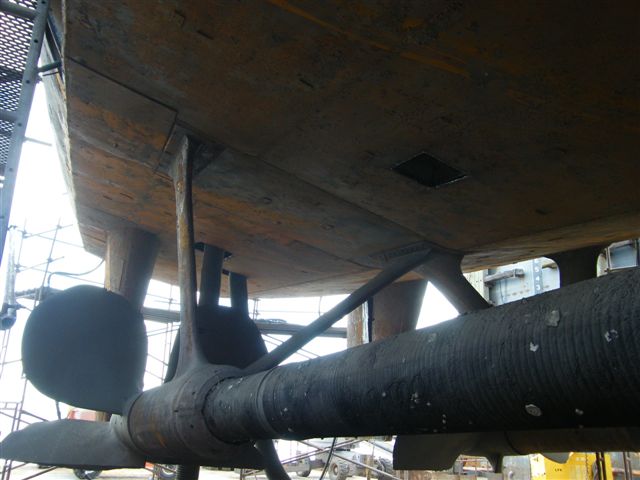
where the shaft appears to be coated with some sort of sheet rubberized (?) sealant. Of course, this might be an "aftermarket" mod. (better look for evidence of large scale PE) But in any case, it is obvious that the shaft isn't metal-sleeved at least.
Also answered is the question of whether the Revell 1:144 model is accurate with their portrayal of the area where the shaft enters the hull as being a distinct large panel assembly ... it isn't. Time to get out the gap filling putty!
These photos of LAFFEY being "repaired" so she won't sink at her museum berth, are not good examples of what operational ships would look like. The shaft to hull interfaces are good, but coatings and extra "chalking/seals" are questionable.
oh well, back to step 1. The Laffey was a Sumner class not a Fletcher class. It turned up in a Fletcher search ... my mistake. One can't compare apples with watermelons.
Except that the materials used for Navy propellers and propeller shafts does not change from Class to Class. Nor do below waterline coatings on non-museum ships at any given time. If you're going to coat a steel hull with anti-fouling paint, why wouldn't you coat the steel shafts too, except where they go through bearings?
Additionally a pair of illustrations by John Robert Barrett also show the same thing. (I don't have the link to those right now but will try to find them ... I have the pics on my computer)
The SUMNER class (short-hull and long-hull ... aka GEARING class) were built on the same hull and with the same machinery plant. Only major differences were the twin rudders and a slightly wider hull (and the longer hull for GEARINGS). So views of the underwater hull would be very similar. What coatings were used can very, the USN experimented with different paints ALL the time. I read one account where this destroyer had about a dozen different underwater primers from different manufactures applied for evaluation in different locations on the hull. A common top coat was applied over the whole thing, so there wouldn't be any notice until the next drydocking, depending on how well the paint worked. There was a "cheat sheet" drawing in the file telling where and who's paint was applied where. And no I didn't scan it and I don't even remember which FLETCHER it was.
Don't trust Barrett's drawings for configuration or anything. They produce drawings that are "pretty" and the same illustration is used for many units ... many times in configurations that ship NEVER had. The display plans for CASSIN YOUNG are not color coded for what they are, just for illustration purposes.
Well I've gone through this thread since last I posted. Still trying to get motivated to finish the 1/144 Fletcher, hoping reading through this will help me.
KevinH wrote:Well I've gone through this thread since last I posted. Still trying to get motivated to finish the 1/144 Fletcher, hoping reading through this will help me.
I've looked at it a lot though
Kevin:
Howdy from up north of you.
Come re-join the fun ... ie: you can make fun of me while I build my USS Leutze!
There will loads of entertainment for all!
Pack a picnic lunch, bring the urchins (and the ball and chain if you must), macaroni salad, and sign up for the '3-masted' race ...(or was that something to do with potatoes???)
KevinH wrote:Well I've gone through this thread since last I posted. Still trying to get motivated to finish the 1/144 Fletcher, hoping reading through this will help me.
I've looked at it a lot though
Hey Kevin,
You were doing a great job with your Johnston .
The Johnston is a great choice of the Fletcher class to build due to her great sacrifice helping to turn the tide of the battle off Samar that fateful day of October 25th 1944.
I encourage you to take your time and continue your build, you will be glad you did.
BTW, were you able to build the tear drop centerline 40mm bulwark for your build?
KevinH wrote:Well I've gone through this thread since last I posted. Still trying to get motivated to finish the 1/144 Fletcher, hoping reading through this will help me.
I've looked at it a lot though
Hey Kevin,
You were doing a great job with your Johnston .
The Johnston is a great choice of the Fletcher class to build due to her great sacrifice helping to turn the tide of the battle off Samar that fateful day of October 25th 1944.
I encourage you to take your time and continue your build, you will be glad you did.
BTW, were you able to build the tear drop centerline 40mm bulwark for your build?
Roger DD-473/DD-555
Thanks, I didn't change it yet. I may stll do it. LOL I did fold one K-Gun rack today hahaha
Hi Kevin,
I'm happy to hear about the PE. There's no need to rush the project, we are not in a race to see who finishes first. Building a ship such as the Johnston, requires a fair amount of scratch work. We all have day jobs that require production of some type or we would loose our jobs. Building model ships is a labor of love and is something to savor. If we rush our work and get burned out it becomes nothing more than a job we must do much like working for a living and all the enjoyment is lost.
codythecatt wrote:oh well, back to step 1. The Laffey was a Sumner class not a Fletcher class. It turned up in a Fletcher search ... my mistake. One can't compare apples with watermelons.
...etc ad nauseum ...lol
I got a definative answer, regarding Fletchers, from my outside source:
As to the screws: I know bronze, but whether alloy I am not sure...the fairings were steel, to the best of my recollection, The shaft was steel. From personal experience, the shaft journal bearings were steel, >400 lbs in weight, with Babbitt metal as the soft metal that cushioned the shaft, using slinger ring lubrication. Just a few more of the facts that, after 53 years, i wish weren't still cluttering up my head!
I still have to contact the source directly and when I do I will credit the citation. I want to contact the Naval Historian at Bremerton's Puget Sount Naval Shipyard ... but that is still proving a little elusive.
Navsource has been having Server problems. There has been a notice posted in the "What's New" section for the Destroyers, anyway, about this for sometime now. There was an indication that "they" (Mr Yarnall) would be seeking a new Server ... I don't know if that has ever happened or is an ongoing process.
An alterative is to check out NHHC's website. Not as many photos, but at least many of the better ones are posted there.
Thank you for that info. I had been viewing the site as recently as last week and was looking for different angles of the sisters of USS Van Valkenburgh. Hopefully the site will come back.
I am happy to see that the Navsource Site is back on line. Must have just been the server problem. Have been downloading like crazy before it goes down again!
When going through the plan CD, I came across a drawing for the skylookout station. The one on the drawing has a bicycle sat and is illustrated in the attached photos that were attached to a Buships directive for their construction. There is one shown at the aft corners of the pilot house roof on the attached photo of the USS LaVallette.
However, the skylookout chairs on the USS Kidd are constructed differently and located at the forward corners of the pilot house roof. When zooming on photos of the USS Van Valkenburgh, I doid not see any at all, so I am wondering if the use of the skylookout stations was optional. Also, whether there are any drawings of the later style, though I know that they are offered in 1/96 scale by John Haynes through the Floating Drydock. I am probably being overly anal over their use and placement, but I would just like to know if there was any standard policy for the skylookout chair use and design.
PeeJay
Attachments
Buships Skylookout design
Buships Skylookout design
Buships Skylookout design
These skylookout chairs from a DE are the same as those on the USS Kidd
The plan for the 650 and later Fletchers shows a pair of chairs on the bridge level each side of the pilot house. They are mounted on the forward corners of the pilot house roof on the Kidd.
Early style skylookout station is visible on the aft port radiuysed corner of the LaValette's pilot house roof.
No skylookout chairs on either level of the USS Hazelwood.
While zooming in on various photos showing the pilot house roofs of low bridge Fletchers in search of skylookout chairs, I came across some "mystery objects." The one shown in the photo of the USS Shields looks like a huge stereo speaker. However, since the ship appears to be in the yard, it could also be some yard equipment, and not an actual part of the ship.
In the photo of the USS Remey (DD 688), there is a structure on the port side of the pilot house roof that appears to be an angle-iron open frame attached to a box fastened to the forward railing on top of the pilot house. There are a bunch of round objects in it that may be helmets, but, if so, I can't tell how they are restrained, and why all that structure is necessary.
The USS Norman Scott (DD 690) has its own angle iron structure on top of the pilot house. Again, the ship may be in the yard, and it could just be some type of workbench.
PeeJay
Attachments
Is that white thing on top of the pilot house a large speaker? (I doubt it!)
"Mystery Structure" is at the far left of the pilot house roof. Large helmet rack?
Is the angle iron structure part of the ship or yard equipment?

 Time to get out the gap filling putty!


 There was a "cheat sheet" drawing in the file telling where and who's paint was applied where. And no I didn't scan it and I don't even remember which FLETCHER it was.
 .
.