There are many waterline plans out there such as those that appear in the books by John Bowen, but I am more interested in full hull models. Say you have a waterline plan with section line detail, you know the general appearance of the lower hull based on photos of other ships by the same builder, and the listed draft of the ship. Can you be reasonably sure of a decent result if you continued the lines below the waterline, based on the info you have?
Say you want to build a different but similar White Star Line ship built by the same yard as the Titanic. For example I think Bowen has the Baltic among his waterline drawings. Could you then use the lines of the Titanic, which are readily available, and interpolate them into the Baltic?
I would assume so, but my real question is can you take a waterline drawing and add enough to match the stated draft of the vessel, or are there other factors that must be considered?
Developing full hull plans from waterline plans
Moderator: JIM BAUMANN
-
Harper57
- Posts: 41
- Joined: Sun Feb 12, 2012 11:10 pm
-
Aop Aur

- Posts: 972
- Joined: Thu Jul 02, 2015 1:06 am
- Location: Bangkok, Thailand
Re: Developing full hull plans from waterline plans
Hello Harper57,
There are several factors to think about. Sometimes similar ships could have very different lower hull shapes, for example the Iowa and Montana classes. These two are considerably similar at a glance, except the greater L&W and number of main armaments on the Montana. Of course they would be completely different in the view of other more expertised modelers and I do not want to discuss into details as I do not have the knowledge! However, I could say that the upper hull of these classes look fairly similar with the Montana having the external armour belt. Meanwhile, taking a look at the cross section of the two, you could see the lower hulls are very different; the Montana's has a large bulging section, while the Iowa's is completely flat and vertical. Not to mention the different stem shapes and other small details. Some ships hull's underside might not be flat as seen on most. So this is something that needs to be noted and researched well before deriving a similar ship's cross sections.
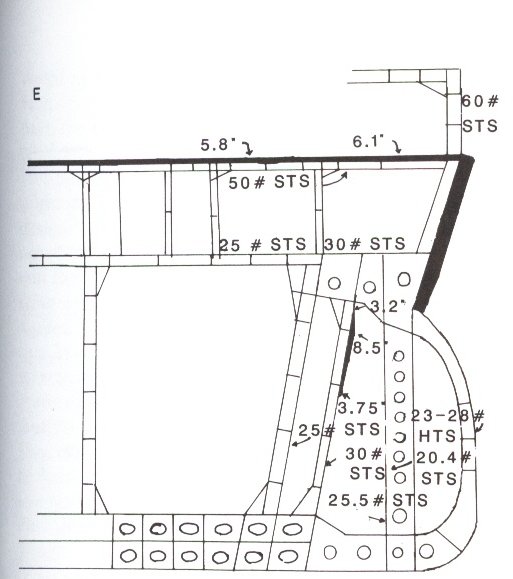

Even though Titanic and Baltic might not have such a contrasting difference, and their length to width ratios may be very similar, there are still several other factors to think of, such as the propeller shaft arrangements, skegs, rudders, bilge keel, hull plating, water in/outlets, etc. Also, if you were to draw your own cross sections, it will require very careful work to make sure each section aligns accurately with the rest to form a nice curve. I have done this myself with a full cross section and still managed to get a bad wavy surface!
Anyhow, it also depends on how accurate you want to go with your models. Even if it doesn't truly follow the real cross-section, you could still be able to achieve a nice-looking lower hull, which could be accurate enough to be unnoticeable for most people. Plus the fact that many kit upper hulls themselves might be erroneous as well.
I am not an expert in ship hull construction, so some info might be better provided by other more knowledgeable people, but I hope this might be useful, or at least it's just my two cents!
Aop
There are several factors to think about. Sometimes similar ships could have very different lower hull shapes, for example the Iowa and Montana classes. These two are considerably similar at a glance, except the greater L&W and number of main armaments on the Montana. Of course they would be completely different in the view of other more expertised modelers and I do not want to discuss into details as I do not have the knowledge! However, I could say that the upper hull of these classes look fairly similar with the Montana having the external armour belt. Meanwhile, taking a look at the cross section of the two, you could see the lower hulls are very different; the Montana's has a large bulging section, while the Iowa's is completely flat and vertical. Not to mention the different stem shapes and other small details. Some ships hull's underside might not be flat as seen on most. So this is something that needs to be noted and researched well before deriving a similar ship's cross sections.
Even though Titanic and Baltic might not have such a contrasting difference, and their length to width ratios may be very similar, there are still several other factors to think of, such as the propeller shaft arrangements, skegs, rudders, bilge keel, hull plating, water in/outlets, etc. Also, if you were to draw your own cross sections, it will require very careful work to make sure each section aligns accurately with the rest to form a nice curve. I have done this myself with a full cross section and still managed to get a bad wavy surface!
Anyhow, it also depends on how accurate you want to go with your models. Even if it doesn't truly follow the real cross-section, you could still be able to achieve a nice-looking lower hull, which could be accurate enough to be unnoticeable for most people. Plus the fact that many kit upper hulls themselves might be erroneous as well.
I am not an expert in ship hull construction, so some info might be better provided by other more knowledgeable people, but I hope this might be useful, or at least it's just my two cents!
Aop
On the way:
--1/350 Tamiya DKM Tirpitz Nov 1944
--1/350 scratch-build HMS Lion never built battleship (1938)
And our artworks!
--1/350 Tamiya DKM Tirpitz Nov 1944
--1/350 scratch-build HMS Lion never built battleship (1938)
And our artworks!
-
Harper57
- Posts: 41
- Joined: Sun Feb 12, 2012 11:10 pm
Re: Developing full hull plans from waterline plans
That�s why I indicated that if you had photos of the ship under construction or in dry dock, you would know the general shapes of the hull and details of propeller bosses, rudders, etc. There seemed to be a distinct difference in these details between Cunard ships like Lusitania and Mauritania, which were built by two different yards to a common design, and Titanic and Olympic built by Harland & Wolff. It�s unlikely that earlier ships built by the same yard were substantially different. Warships I think are a different story.
I think I�m answering my own question, but I would still like input on whether the stated waterline is indeed the distance from the waterline on a waterline drawing, to the bottom of the hull.
I think I�m answering my own question, but I would still like input on whether the stated waterline is indeed the distance from the waterline on a waterline drawing, to the bottom of the hull.
-
John W.

- Posts: 518
- Joined: Tue Mar 27, 2007 12:34 pm
- Location: Smithfield, Virginia
Re: Developing full hull plans from waterline plans
Harper
You would be on safe ground to expect sister ships to be essentially the same hull and plans essentially identical for hull lines. Beyond that, I don't think you can generalize as much. Using the above example, IOWA and MONTANA are two very different ship classes that look similar, but really aren't. The IOWAs were designed for 35 Kts and to fit through the Panama Canal, and were to a degree hamstrung by the naval treaties of the twenties and thirties. MONTANAs had different design considerations such as considerably slower design speeds (I think 28 Kts, but don't shoot me if I'm a Knot off), design not affected by treaties, and were intentionally too wide for the PC, I think in order to get more armor on the sides, carry the fourth turret with the extra guns and ammo. These design features may have been the result of learning about the YAMATOs' actual size and armament. Just a guess. They were quite different ships all things considered, and their hulls were quite different as well for your purposes. Just an example. But same would be true of other ships, even produced by the same yard - depends upon design requirements. (Don't forget the third ship of the class - Brittanic by the way. Shipyards tend to be pretty conservative so I think the comment about similarities between ships produced by the same yard within, say, a decade of each other is reasonable for non-military ships. TITANIC's stern looks a lot like that of a turn of the century (1900) sailing ship for example.)
Do you have a specific ship in mind? It might be that someone here might be able to help you find the right plans so you wouldn't have to extrapolate. Answer to your question about the waterline is: maybe yes, maybe no. Not every ship's water line is parallel to the ship's bottom. Some ships have a shallower draft at the bow than at the stern for example.
You would be on safe ground to expect sister ships to be essentially the same hull and plans essentially identical for hull lines. Beyond that, I don't think you can generalize as much. Using the above example, IOWA and MONTANA are two very different ship classes that look similar, but really aren't. The IOWAs were designed for 35 Kts and to fit through the Panama Canal, and were to a degree hamstrung by the naval treaties of the twenties and thirties. MONTANAs had different design considerations such as considerably slower design speeds (I think 28 Kts, but don't shoot me if I'm a Knot off), design not affected by treaties, and were intentionally too wide for the PC, I think in order to get more armor on the sides, carry the fourth turret with the extra guns and ammo. These design features may have been the result of learning about the YAMATOs' actual size and armament. Just a guess. They were quite different ships all things considered, and their hulls were quite different as well for your purposes. Just an example. But same would be true of other ships, even produced by the same yard - depends upon design requirements. (Don't forget the third ship of the class - Brittanic by the way. Shipyards tend to be pretty conservative so I think the comment about similarities between ships produced by the same yard within, say, a decade of each other is reasonable for non-military ships. TITANIC's stern looks a lot like that of a turn of the century (1900) sailing ship for example.)
Do you have a specific ship in mind? It might be that someone here might be able to help you find the right plans so you wouldn't have to extrapolate. Answer to your question about the waterline is: maybe yes, maybe no. Not every ship's water line is parallel to the ship's bottom. Some ships have a shallower draft at the bow than at the stern for example.
Some people make you happy, then they leave.
Others make you happy when they leave. (apologies to Oscar Wilde if he ever said anything similar, of which there is some doubt . . .)
Others make you happy when they leave. (apologies to Oscar Wilde if he ever said anything similar, of which there is some doubt . . .)